
Bernoullis Theorem
Daniel Bernoulli (1700 - 1782) investigated not only mathematics but also such fields as medicine, biology, physiology, mechanics, physics, astronomy, and oceanography.
Bernoulli'\b{s theorem}, which he derived, is named after him.
Key Facts:
Definition
is density [kg/m\^3]
- v is velocity [m/s]
- P is pressure [N/m\^2]
- g is accretion due to gracity [m/s\^2]
- z is vertical elevation
- h_L is the head lost due to friction
The background to Bernoulli's Theorem.
You're viewing an older version of this page (#3807). View the current version.
Overview
![Fig 1. Venturi Tube - Figure courtesy Wikipedia \url [http://en.wikipedia.org/]](/users/23573%2Fventuriflow.png)
Bernoulli's principle states that in a steady, streamlined, incompressible flow of a fluid, the pressure of the fluid is inversely proportional to its velocity. If a fluid is flowing through a horizontal pipe of varying cross-sectional area, as in Figure 1 for example, the fluid speeds up in constricted areas so that the pressure the fluid exerts is least where the cross section is smallest. This phenomenon is also called the Venturi effect. The Venturi effect has several applications including that associated with generating lift atop an aerofoil, making all forms of flight on aeroplanes, gyroplanes, and helicopters possible.
Note: The Bernoulli's theorem is also the law of conservation of energy, i.e. the sum of all energy in a steady, streamlined, incompressible flow of fluid is always a constant.
Theorem
Proof
Consider the motion of a fluid down a steam tube.
Consider the motion of an isolated volume a,b,c,d. After a time it is at position a',b',c',d',and since the volume a',b',c,d, is equal in to both, then the net change is equivalent to moving the mass of fluid from a,b,b',a', to c,d,c',d'.
The work done by the pressure on AB in time =
All the work is expended in:
- a) Doing work against the pressure at
i.e.
- b) Raising the weight of
,
,
,
,
- c) Increasing the kinetic energy of
',
i.e.
Equating (#1) to the work expended
where
Constant
This equation can be expressed in three ways:
- (2)
where C is constant
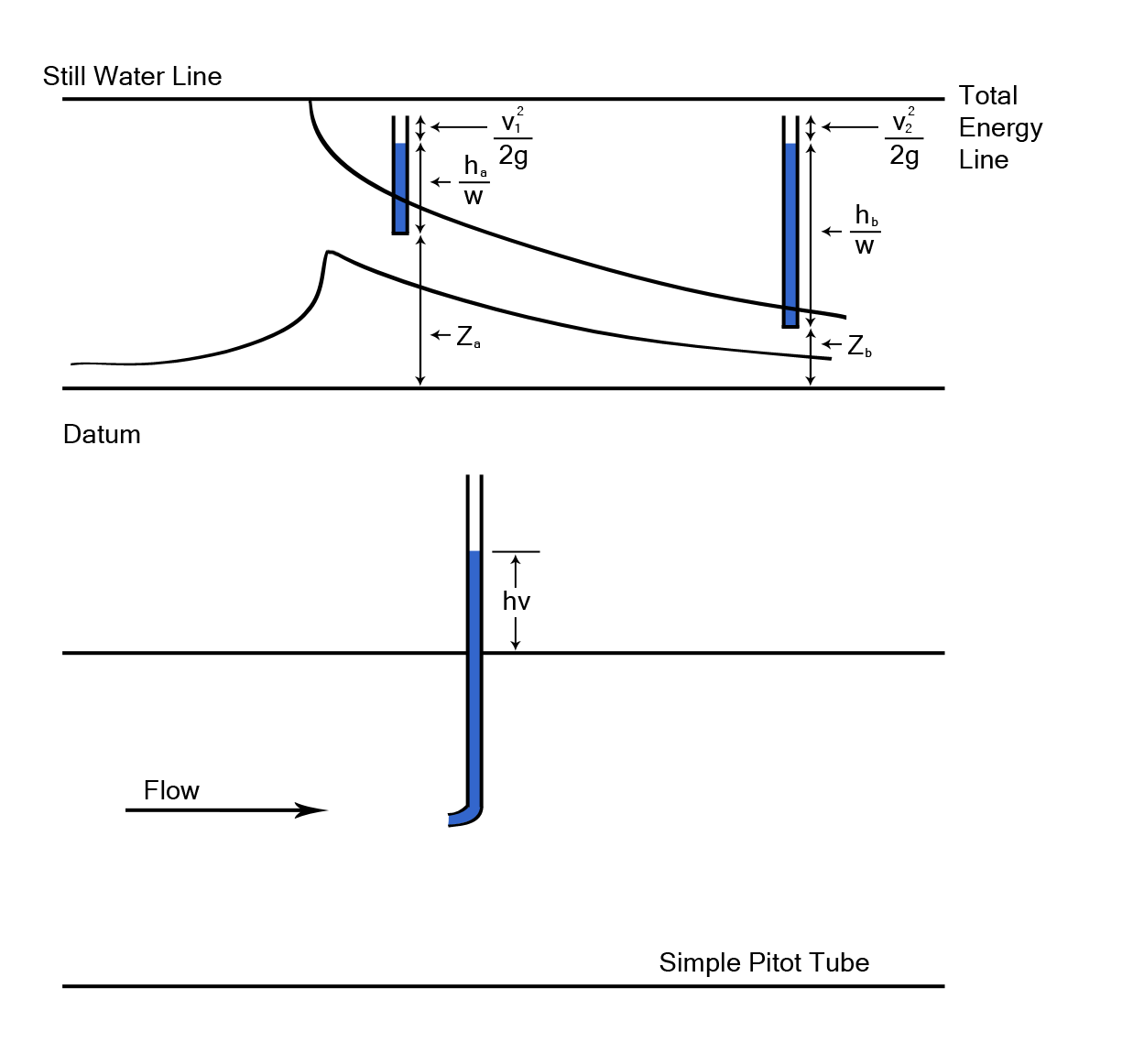
Notice: that the above equations make no allowance for a head lost due to Friction and it is normal to write Bernoulli'\b{s Equation} as: where
is the head lost due to friction.
See Also
- http://www.codecogs.com/reference/engineering/fluid_mechanics/pipes/the_flow_through_pipes.php"The Flow through Pipes"