
Bernoullis Theorem
The background to Bernoulli's Theorem
You're viewing an older version of this page (#3766). View the current version.
Theorem
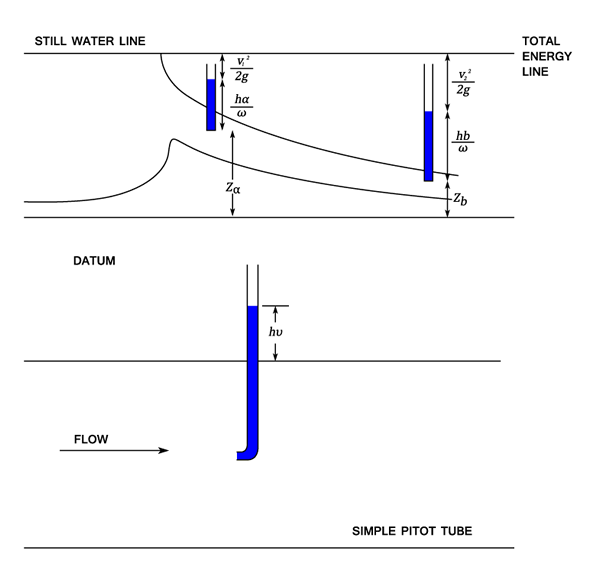
Consider the motion of a fluid down a steam tube
Consider the motion of an isolated volume a, b, c, d. After a time it is position a',b',c',d',and since the volume a',b',c ,d, is to both. The net change is equivalent to moving the mass of fluid from a,b,b',a', to c,d,c',d',
The work done by the pressure on AB in time dt =
All the work is expended in:
- a) Doing work against the pressure at CD i.e.
- b) Raising the weight of A,B,B',A', to C,D,C',D', i.e.
- c) Increasing the kinetic energy of A,B,B',A', to that of C,D.C',D',
i.e.
Equating 1 to the work expended
The equation can be expressed in three ways:
- (4)
- (5)
- (6)
Consider the motion of an isolated volume a, b, c, d. After a time it is position a',b',c',d',and since the volume a',b',c ,d, is to both. The net change is equivalent to moving the mass of fluid from a,b,b',a', to c,d,c',d',
The work done by the pressure on AB in time dt =
All the work is expended in:
- a) Doing work against the pressure at CD i.e.
- b) Raising the weight of A,B,B',A', to C,D,C',D', i.e.
- c) Increasing the kinetic energy of A,B,B',A', to that of C,D.C',D',
i.e.
Equating 1 to the work expended
The equation can be expressed in three ways:
- (10)
- (11)
- (12)
Notice
For more on Bernoulli Equation and for worked examples, please see our new section on The Flow through Pipes. The new page also gives the Darcy equation for the frictional loss in pipes as well as the Chezy formula and Poiseuille Equation for laminar Flow